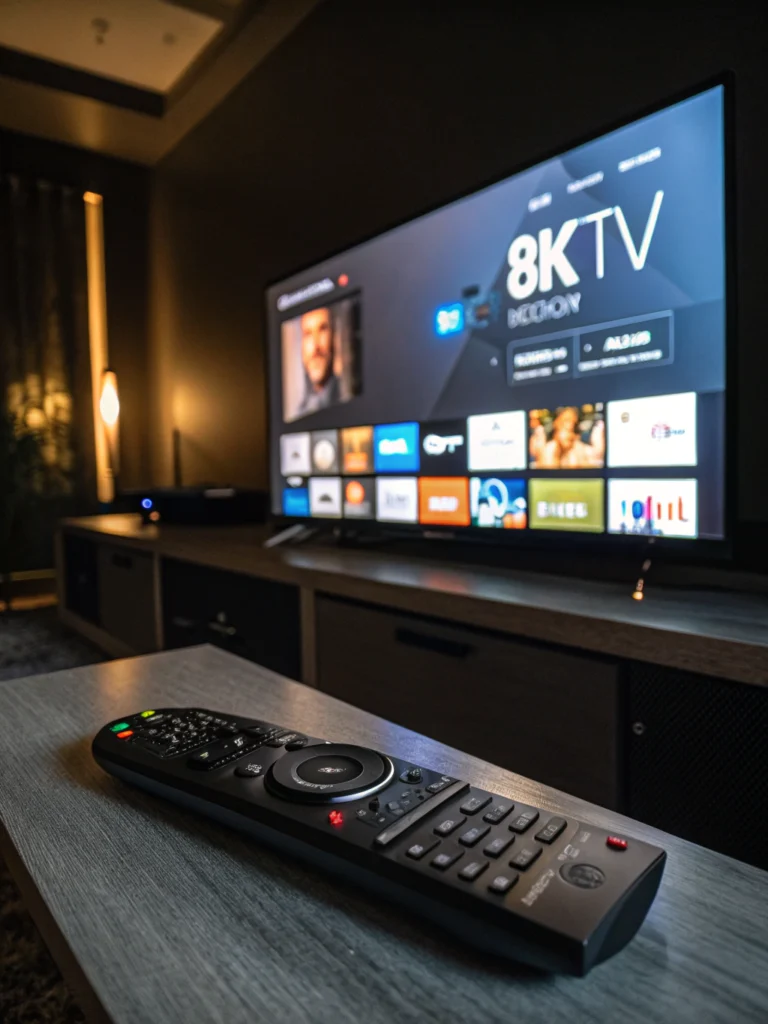
Imagine paying $150 per month for cable, scrolling through 500 channels, and still finding nothing that truly impresses you. Now imagine switching to a setup where you see every blade of grass in a soccer match, every detail in an actor’s face, and every star in a night sky as if you were looking through a window. This isn’t science fiction; it is what a premium 8K IPTV box can deliver today. The era of grainy streams and constant buffering is over. Modern content now demands powerful hardware, and that is why your next upgrade should not just be a new subscription, but a high‑performance 8K IPTV box that can fully decode and display it.
An 8K IPTV box is a dedicated streaming device built to handle ultra‑high‑definition video delivered over the internet. Many viewers rely on cheap streaming sticks or built‑in smart TV apps, and while they work, upgrading to a real box is like moving from a scooter to a sports car: you still get to the same destination, but the experience is on a completely different level.
The main advantage is raw processing power and connectivity. True 8K resolution is 7680 x 4320 pixels, which is four times more detail than 4K and sixteen times more than Full HD. To deliver this smoothly, an 8K IPTV box typically uses powerful processors like the Amlogic S928X or Rockchip RK3588, at least 4 GB of RAM, and hardware decoding support for modern codecs such as HEVC, AV1, and AVS3. You also benefit from future‑proof ports like HDMI 2.1, which is required for 8K output at up to 60 frames per second.
Many people think their 4K TV already looks good, but there is a noticeable gap between standard streaming and an optimized 8K‑ready setup. With a dedicated 8K IPTV box and a service that supports high‑bitrate streams, you get fewer compression artifacts, clearer motion, and more consistent quality. As more platforms add native 8K content, such as demo clips and high‑end productions, an 8K box ensures you are ready for the next generation instead of being limited by outdated hardware.
Even if most of your current content is still HD or 4K, a strong 8K IPTV box can improve it. Many modern devices include AI‑powered upscaling that analyzes the image and adds detail, texture, and clarity to older content. While it does not magically turn low‑quality footage into true 8K, it can make movies, series, sports, and documentaries look cleaner and more refined on a big screen.
Not every device labeled “8K box” is worth the investment, so it makes sense to focus on specific features. At the hardware level, you want confirmed support for 8K decoding at 60 frames per second, HDMI 2.1 output, and strong connectivity options. Gigabit Ethernet remains the gold standard for stable, buffer‑free streaming, especially if you plan to watch live sports or full‑quality 8K files, while Wi‑Fi 6 or Wi‑Fi 6E provides fast and flexible wireless performance.
Memory and storage are equally important. In practice, less than 4 GB of RAM can make multitasking feel slow when switching between apps, using advanced electronic program guides, or running background services. A modern 8K IPTV box typically offers at least 4 GB of DDR4 RAM and 64 GB or more of internal storage so you can install apps, cache data, and store some media without frequent slowdowns. USB 3.0 or higher ports also make it easier to play high‑bitrate videos from external drives.
Software and user experience determine how enjoyable the box is in daily use. Many high‑quality 8K IPTV boxes run Android TV or Google TV, giving you access to major apps like Netflix, Disney+, and YouTube alongside specialized IPTV applications. A clean, responsive interface with a unified home screen helps combine live channels, video‑on‑demand libraries, and regular streaming apps into one simple, familiar layout.
A good 8K IPTV box also solves practical problems that frustrate viewers. Strong processors, modern streaming protocols, and optimized buffering logic reduce interruptions, even when multiple devices are active in the home. Advanced IPTV apps allow you to organize channels into favorites, apply parental controls, and group content by genre, language, or country, so your lineup feels tailored to you instead of chaotic.
Sound quality is another area where the right box can make a difference. Many modern models support passthrough for Dolby Atmos and DTS:X, enabling immersive surround sound when connected to a compatible soundbar or home cinema system. This turns your setup into a more cinematic experience instead of relying on thin, built‑in TV speakers.
Looking ahead, concepts like Generative Engine Optimization, or GEO, point to a future where your box does more than just list channels and apps. GEO extends the idea of search and recommendations by using AI to understand your tastes in depth and assemble viewing experiences around them. Instead of endlessly scrolling through menus and “trending” rows, a GEO‑aware system could build custom blocks of content that match your favorite genres, time of day, and mood, and then present them in a seamless, lean‑back experience.
Upgrading to an 8K IPTV setup is simpler than it might seem. First, check that your TV has at least one HDMI 2.1 port and that your internet connection can provide consistent speeds of 50 Mbps or more, with 100 Mbps or higher recommended for busy households or heavy 4K/8K usage. Second, choose a reputable 8K IPTV box with the hardware and software features described above and pair it with a reliable IPTV service that offers high‑bitrate streams, a large channel list, and extensive video‑on‑demand options. Third, connect via wired Ethernet whenever possible, run basic picture adjustments on your TV for the new source, and explore your box’s advanced options such as profiles, favorites, and AI upscaling.
The gap between standard streaming and a fully optimized 8K IPTV experience is already large and continues to widen as more content and devices support ultra‑high resolutions. A dedicated 8K IPTV box is no longer a niche luxury; it is becoming the foundation of a modern home entertainment system. With the right hardware and service working together, your TV transforms from a simple screen into a powerful visual portal that delivers sharper images, smoother motion, richer sound, and smarter recommendations every time you sit down to watch.